Rebecca Wu: A Room Rehearsal Its Own: Curated by Xiaojing Zhu
But the present was full of strangers.
And in some way, it was all exactly right,
exactly as I remembered: the house, the street,
the prosperous village—
Not to be reclaimed or re-entered
but to legitimize
silence and distance,
distance of place, of time,
bewildering accuracy of imagination and dream—
I remember my childhood as a long wish to be elsewhere.
This is the house; this must be
the childhood I had in mind.
LATITUDE Gallery is delighted to present A Room Rehearsals Its Own, the third solo exhibition of Xiangjie Rebecca Wu, curated by Xiaojing Zhu. The exhibition debuts Wu’s latest series of paintings centered on enigmatic interior spaces, rooms that are emptied of linear narrative yet saturated with duration. In these works, what remains is time: condensed, layered, and palpable. The room becomes less a setting than a condition, where memory takes on material form.
Resonating with Louise Glück’s poems, This is the House, Wu’s paintings reveal a reciprocal relationship between subjective memory and the scenario from which memory originates. Instead of chasing the legibility or likeness of recollection, Wu paints a reconstruction in which memory regains its density.
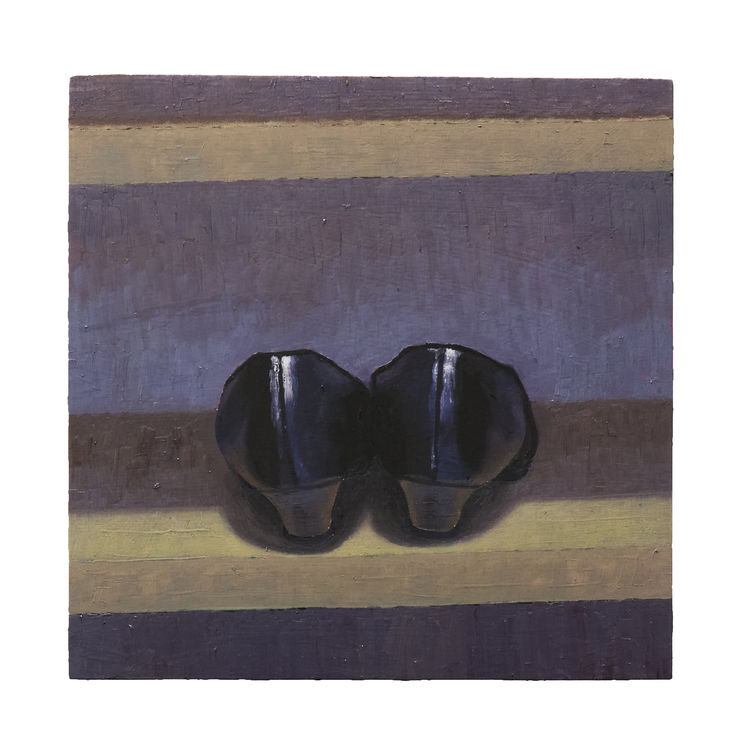
The rectangular showroom with paintings subtly mirrors a domestic room layout: paintings of neatly arranged shoes are installed low to the ground, while depictions of doors and windows face one another along the corridor, with chairs positioned in the middle of the space...extending the atmosphere of lived domestic order.
At the threshold, viewers are greeted by a painted hand—an open palm holding several glass marbles in varying sizes. The gesture remains deliberately ambiguous: it may be read as an offering of welcome, or as an adult presenting obsolete treasures from his childhood. The hand does not explain itself; it performs a suspended action, inviting interpretation while resisting closure. As one’s gaze moves past those paintings of doors and windows lining both sides, at its far end stands a nostalgic bamboo ladder, leaning within a dimly lit room. Above it hangs a clock, positioned where a moon should be. This misleading correspondence is subtle yet exacting, as though interior and exterior have been inverted, time itself has been spatially choreographed. Diagonally across the exhibition space, a painting of two chairs hangs silently behind the reception desk. Their proximity suggests a shared yet fractured occupancy. No figures appear, yet the relational attachment and absence are unmistakable.
Anchored by these recurring elements: round mirrors, dense wooden furniture, shadows cast by moonlight...the noun becomes active, almost verbal. In close affinity with poetry, Wu proposes a quiet contract, from which presence outweighs explanation. These interior narratives may displace empirical reality, yet they achieve an authenticity more intimate than fact.
As chronological time dissolves, the intrinsic texture of memory surfaces. Devoid of human figures, the room nonetheless clarifies memory with striking precision. Through this process, memory is resolidified, reconstructed, and condensed into a tangible, affirmed presence.
-
 Xiangjie Rebecca WuIs That The Night We Lost_ 2, 2025Oil on Linen36 x 48 in
91.4 x 121.9 cmCourtesy of Latitude Gallery New YorkCopyright The Artist -
Xiangjie Rebecca WuThrough A Galss Darkly, 2025Oil on Wood Panel16 x 16 in
40.6 x 40.6 cmCourtesy of Latitude Gallery New YorkCopyright The Artist -
Xiangjie Rebecca WuStill In The Mirror, 2025Oil on Linen50 x 60 in
127 x 152.4 cmCourtesy of Latitude Gallery New YorkCopyright The Artist -
Xiangjie Rebecca WuLetter to Time, 2025Oil on Canvas55 x 60 in
139.7 x 152.4 cmCourtesy of Latitude Gallery New YorkCopyright The Artist -
Xiangjie Rebecca WuShoes II, 2025Oil on Wood Panel10 x 10 in
25.4 x 25.4 cmCourtesy of Latitude Gallery New YorkCopyright The Artist -
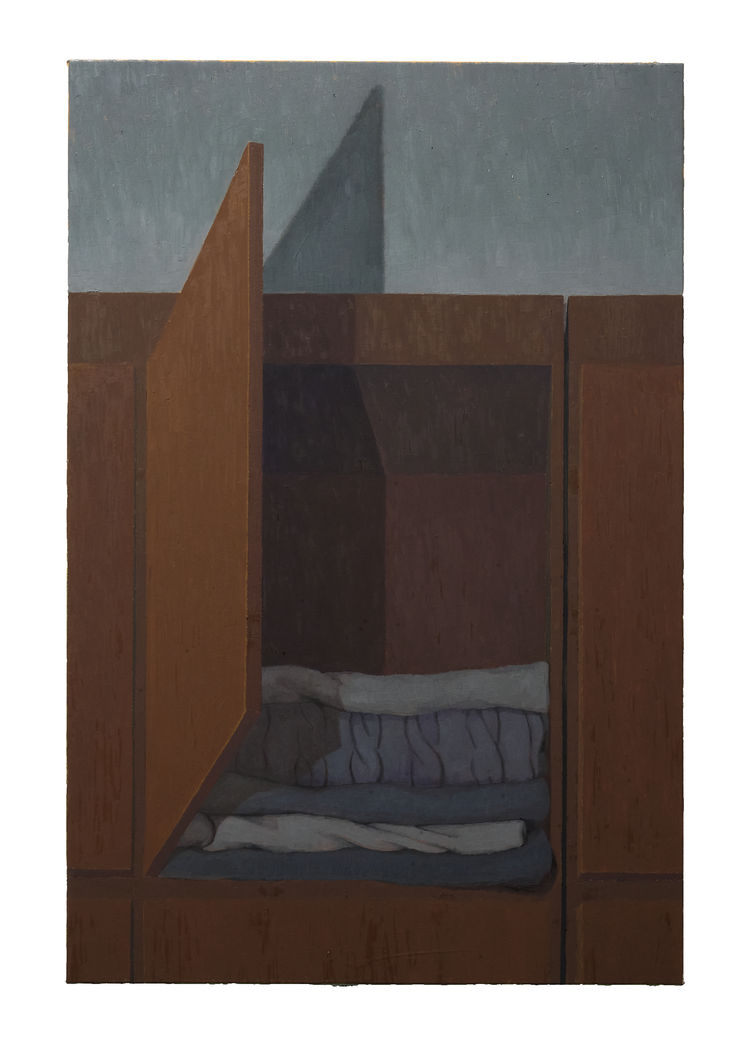
Xiangjie Rebecca WuGrey Cardigans, 2025Oil on Canvas24 x 36 in
61 x 91.4 cmCourtesy of Latitude Gallery New YorkCopyright The Artist -
Xiangjie Rebecca WuBlue Chamber II, 2025Oil on Canvas48 x 60 in
121.9 x 152.4 cmCourtesy of Latitude Gallery New YorkCopyright The Artist -
Xiangjie Rebecca WuBowls VI, 2025Oil on Linen24 x 30 in
61 x 76.2 cmCourtesy of Latitude Gallery New YorkCopyright The Artist -
Xiangjie Rebecca WuBowls III, 2025Oil on Wood Panel12 x 12 in
30.5 x 30.5 cmCourtesy of Latitude Gallery New YorkCopyright The Artist -
Xiangjie Rebecca WuBlue Soliloquy, 2025Oil on Canvas40 x 48 in
101.6 x 121.9 cmCourtesy of Latitude Gallery New YorkCopyright The Artist -
Xiangjie Rebecca WuAbout the Self He Cannot See, 2025Oil on Canvas48 x 48 in
121.9 x 121.9 cmCourtesy of Latitude Gallery New YorkCopyright The Artist -
Xiangjie Rebecca WuTwo Chair, 2025Oil on Linen30 x 36 in
76.2 x 91.4 cmCourtesy of Latitude Gallery New YorkCopyright The Artist -
Xiangjie Rebecca WuFor I Know What I Have For You, 2025Oil on Wood Panel8 x 4 in
20.3 x 10.2 cmCourtesy of Latitude Gallery New YorkCopyright The Artist -
Xiangjie Rebecca WuThe Shimmer, 2025Oil on Wood Panel11 x 14 in
27.9 x 35.6 cmCourtesy of Latitude Gallery New YorkCopyright The Artist -
Xiangjie Rebecca WuShoes III, 2025Oil on Wood Panel12 x 12 in
30.5 x 30.5 cmCourtesy of Latitude Gallery New YorkCopyright The Artist -
Xiangjie Rebecca WuKnitting II,, 2025Oil on Wood Panel4 x 4 in
10.2 x 10.2 cmCourtesy of Latitude Gallery New YorkCopyright The Artist -
Xiangjie Rebecca WuMah-jong, 2025Oil on Wood Panel4 x 4 in
10.2 x 10.2 cmCourtesy of Latitude Gallery New YorkCopyright The Artist -
Xiangjie Rebecca WuRed Comb, 2025Oil on Wood Panel11 x 14 in
27.9 x 35.6 cmCourtesy of Latitude Gallery New YorkCopyright The Artist -
Xiangjie Rebecca WuShoes I, 2025Oil on Wood Panel12 x 12 in
30.5 x 30.5 cmCourtesy of Latitude Gallery New YorkCopyright The Artist -
Xiangjie Rebecca WuPlate IV, 2025Oil on Wood Panel14 x 11 in
35.6 x 27.9 cmCourtesy of Latitude Gallery New YorkCopyright The Artist -
Xiangjie Rebecca WuIn The Closet, 2025Oil on Canvas55 x 65 in
139.7 x 165.1 cmCourtesy of Latitude Gallery New YorkCopyright The Artist -
Xiangjie Rebecca WuClock, 2025Oil on Wood Panel16 x 20 in
40.6 x 50.8 cmCourtesy of Latitude Gallery New YorkCopyright The Artist