No Place Like Home: Co-curated with Civil Art
LATITUDE Gallery is pleased to present No Place Like Home, an end-of-the-year collaborative group show co-curated with Civil Art. Co-founded and led by artist Ho Jae Kim, Civil Art is a nonprofit organization dismantling barriers to professional success for API (Asian Pacific Islander) artists, art writers, and cultural professionals. Civil Art functions as connective tissue in the arts ecosystem, building the networks, providing the milestones, and creating the foundations that turn creative potential into lasting cultural leadership. In this sense, Latitude Galley has long held a vision that Civil Art echoes, supporting Asian diasporic artists and fostering their visibility across New York and the wider global landscape.
In this show, Civil Art presents the 2025–2026 cohort of its emerging artist leadership program, Art House — Andrius Alvarez-Backus, Claire Chey, Herok Kim, Hyun Sun Ohm, In June Park, Joanne Ji Young Kim, Rayer Ma, Sharon Cheuk Wun Lee, and Wenhui Quan. Meanwhile, Curated by Weifan Mo and Xumeng Zhang, Latitude Gallery brings together a notable group of emerging artists in resonance — Grace Chang, Cherina Cheng, Claudia Kohn, Ailyn Lee, Shivani Mithbaokar, Grace Qian, Jiayu Wei, Wendy Wei, Cass Yao, and Theresia Zhang. Together, No Place Like Home gathers artists who use the familiar as a gateway to the unknown, thus reconfiguring the latent affect of everydayness.
Recognizing what we have right in front of us—what is closest, most familiar—can be surprisingly difficult. Often it takes distance, a journey away from the everyday, to perceive the textures of our lives with clarity. What we recognize becomes uncanny; what feels intimate becomes dislocated. In this space of shifting meaning, viewers are invited to embark on their own journey—one that is philosophical, cultural, psychological, or somewhere in between.
Through textiles, patterns, objects, and materials drawn from domestic or cultural vernaculars, each artist constructs a passage outward. In Just Between Us, Anrius Alvarez-Backus “reclaims” found objects and expands their material identity beyond their original context, transforming them into an abstracted sense of reality: their faded washes and worn tones evoke something of humanity, suggesting a terrain shaped not by nature but by lived experience. In Threshold #1, Herok layers hanji—a traditional Korean paper—with toilet paper to create a dense, relief-like surface that represents the humble and easily overlooked materials of everyday life. As the layers thicken, Herok carves into the paper with chiseling tools, cutting grooves across the surface like tire tracks pressed into fresh snow, through which the artist transforms these ordinary materials into a passage into a phantasmagoric thicket of trees, a bridge to the otherworldly.
In Welcome In [Huan Ying Guang Lin], Claudia Koh explores the space in suspension between the city’s nocturnal glow and the quiet intimacy of the domestic. The pensive face foregrounding the painting, and her hair glinting with the city’s distant, wavering lights, together gesture toward the estranged inner state of an urban resident seen as a mirrored apparition. In Blue Ribbon, Grace Qian refashions a corner of the bedroom into a vertically stratified territory. Under this subtle yet ingenious shift of vantage, the striking blue of the suitcase under the bed becomes the furtive gaze of a parallel interior, lending the still-life of the room an almost theatrical charge.
Here, the familiar is both medium and point of departure. These works chart routes across internal and external terrains, guiding us through landscapes shaped by memory, identity, and lived experience. The path ultimately circles back, returning us to where we began: home. But the return is not a simple restoration. Instead, we come back changed—transformed not physically but perceptually, newly attuned to what has always accompanied us.
In revealing the extraordinary within the ordinary, the artists in No Place Like Home remind us that distance can illuminate, and that home itself is an ever-shifting horizon, understood anew each time we cross it again.


-
 Ailyn LeeLast Cigarette, 2025Water Soluble Pastel and Colored Pencil, Wood Stain, Nobang Silk, Drawer Handle, Lock and Key on Engraved Panel16 x 20 x 2 in
40.6 x 50.8 x 5.1 cmCourtesy of Latitude Gallery New YorkCopyright The Artist -
Ailyn LeeMy Autumn Lamp, 2025Water Soluble Pastel and Colored Pencil, Wood Stain, Drawer Handle, Norigae on Engraved Panel16 x 20 x 2 in
40.6 x 50.8 x 5.1 cmCourtesy of Latitude Gallery New YorkCopyright The Artist -
Ailyn LeeNighttime Routine, 2023Engraved Drawer, Stone Clay, Acrylic, Wood stain, Pigment, Thread, Epoxy16 x 13 x 3 1/2 in
40.6 x 33 x 8.9 cmCourtesy of Latitude Gallery New YorkCopyright The Artist -
Wendy WeiBrace Me Brace You , 2023Gouache on Paper Over Panel
16 x 20 in
40.6 x 50.8 cmCourtesy of Latitude Gallery New YorkCopyright The Artist -
Wendy WeiHoliday Harvest , 2025Oil and Acrylic on Canvas24 x 30 in
61 x 76.2 cmCourtesy of Latitude Gallery New YorkCopyright The Artist -
Wendy WeiOn a Quiet Night, Do You Falter, 2025Oil and Acrylic on Linen
12 x 16 in
30.5 x 40.6 cmCourtesy of Latitude Gallery New YorkCopyright The Artist -
Wendy WeiOriental Tears , 2025Oil and Wax on Wood6 x 6 in
15.2 x 15.2 cmCourtesy of Latitude Gallery New YorkCopyright The Artist -
Jiayu WeiYour Blood, My Tongue, 2025Oil, Mix Media on Canvas15 3/4 x 11 3/4 in
40 x 30 cmCourtesy of Latitude Gallery New YorkCopyright The Artist -
Jiayu WeiSpit Out The Wicked Eye, 2025Oil on Canvas11 3/4 x 15 3/4 in
30 x 40 cmCourtesy of Latitude Gallery New YorkCopyright The Artist -
Jiayu WeiShadow Play, 2025Oil on Wood9 x 8 in
23 x 20 cmCourtesy of Latitude Gallery New YorkCopyright The Artist -
Jiayu WeiPurple Puffer Coat, 2025Oil on Wood9 x 8 in
23 x 20 cmCourtesy of Latitude Gallery New YorkCopyright The Artist -
Theresia ZhangSuffocation, 2025Oil on Linen8 x 10 in
20.3 x 25.4 cmCourtesy of Latitude Gallery New YorkCopyright The Artist -
Theresia ZhangWhere His Eyes Rest (The Painted Veil, 1925), 2025Oil on Linen20 x 16 in
50.8 x 40.6 cmCourtesy of Latitude Gallery New YorkCopyright The Artist -
Theresia ZhangFlying Metal Capsule, 2025Oil on Board24 x 18 in
61 x 45.7 cmCourtesy of Latitude Gallery New YorkCopyright The Artist -
Grace QianAfterimage, 2024Oil on Linen45 x 22 in
114.3 x 55.9 cmCourtesy of Latitude Gallery New YorkCopyright The Artist -
Grace QianLooking In, 2025Oil on Canvas24 x 12 in
61 x 30.5 cmCourtesy of Latitude Gallery New YorkCopyright The Artist -
Grace QianBlue Ribbon, 2024Oil on Linen34 x 15 in
86.4 x 38.1 cmCourtesy of Latitude Gallery New YorkCopyright The Artist -
Grace QianRecalibration, 2025Oil on Linen18 x 10 in
45.7 x 25.4 cmCourtesy of Latitude Gallery New YorkCopyright The Artist -
Shivani MithbaokarLay of the Land, 2025Fabric, Acrylic on Canvas16 x 12 in
40.6 x 30.5 cmCourtesy of Latitude Gallery New YorkCopyright The Artist -
Shivani MithbaokarAncestor II, 2024Found Fabric, Fabric Threads, Acrylic and Gouache on Canvas60 x 34 in
152.4 x 86.4 cmCourtesy of Latitude Gallery New YorkCopyright The Artist -
Shivani MithbaokarTender Tendrils, 2025Found Fabric, Fabric Threads, Acrylic on Canvas, Found Object14 5/8 x 12 3/4 in
37.1 x 32.4 cmCourtesy of Latitude Gallery New YorkCopyright The Artist -
Shivani MithbaokarA Sacred Submarine, 2025Gouache on Wallpaper, Wood37 1/2 x 36 1/4 in
95.3 x 91.9 cmCourtesy of Latitude Gallery New YorkCopyright The Artist -
Claudia KohEquilibrium, 2025Oil on Canvas25 5/8 x 16 1/8 in
65 x 41 cmCourtesy of Latitude Gallery New YorkCopyright The Artist -
Claudia KohHuan Ying Guang Lin, 2025Oil on Canvas11 3/4 x 9 in
30 x 23 cmCourtesy of Latitude Gallery New YorkCopyright The Artist -
Claudia KohNian Nian You Yu, 2025Oil on Canvas16 1/8 x 20 1/8 in
41 x 51 cmCourtesy of Latitude Gallery New YorkCopyright The Artist -
Cherina ChengCovering to Covers, 2025Oil on Linen47 x 47 in
119.4 x 119.4 cmCourtesy of Latitude Gallery New YorkCopyright The Artist -
Cherina ChengJourney to the West, 2025Oil on Linen47 x 48 in
119.4 x 121.9 cmCourtesy of Latitude Gallery New YorkCopyright The Artist -
Cherina ChengBefore the Marrying Party, 2024Oil on Linen50 x 60 in
127 x 152.4 cmCourtesy of Latitude Gallery New YorkCopyright The Artist -
Grace ChangNot a Circle, 2025Acrylic on Panel9 x 12 in
22.9 x 30.5 cmCourtesy of Latitude Gallery New YorkCopyright The Artist -
Grace Changhand me down, 2023Colored Pencil on Cradled Panel24 x 30 x 1 in
61 x 76.2 x 2.5 cmCourtesy of Latitude Gallery New YorkCopyright The Artist -
Grace ChangFamiliar Smells, 2025Acrylic on Panel8 x 8 in
20.3 x 20.3 cmCourtesy of Latitude Gallery New YorkCopyright The Artist -
Grace ChangIt Used to Be a Well, 2025Colored Pencil on Cradled Panel16 x 20 x 1 in
40.6 x 50.8 x 2.5 cmCourtesy of Latitude Gallery New YorkCopyright The Artist -
Joanne KimWinter Visitors, 2025Acrylic on Canvas24 x 20 in
61 x 50.8 cmCourtesy of Latitude Gallery New YorkCopyright The Artist -
Joanne KimMoon Nest, 2025Acrylic and Oil on Canvas60 x 49 in
152.4 x 124.5 cmCourtesy of Latitude Gallery New YorkCopyright The Artist -
HerokThreshold #2, 2025Hanji Paper, Pigment, House Paint, Acrylic, Plaster, Toilet Paper on Canvas24 x 30 in
61 x 76.2 cmCourtesy of Latitude Gallery New YorkCopyright The Artist -
HerokThreshold #1, 2025Hanji Paper, Pigment, House Paint, Acrylic, Plaster, Toilet Paper on Canvas36 x 36 in
91.4 x 91.4 cmCourtesy of Latitude Gallery New YorkCopyright The Artist -
Sharon Cheuk Wun LeeAfterimage: Borrowed Flora, 2025Engraving on Aluminum60 x 40 in
152.4 x 101.6 cmCourtesy of Latitude Gallery New YorkCopyright The Artist -
Claire CheyUntitled, 2025Oil on Canvas24 x 24 in
61 x 61 cmCourtesy of Latitude Gallery New YorkCopyright The Artist -
Claire CheyMother in my Dream #2, 2025Oil on Panel18 x 24 in
45.7 x 61 cmCourtesy of Latitude Gallery New YorkCopyright The Artist -
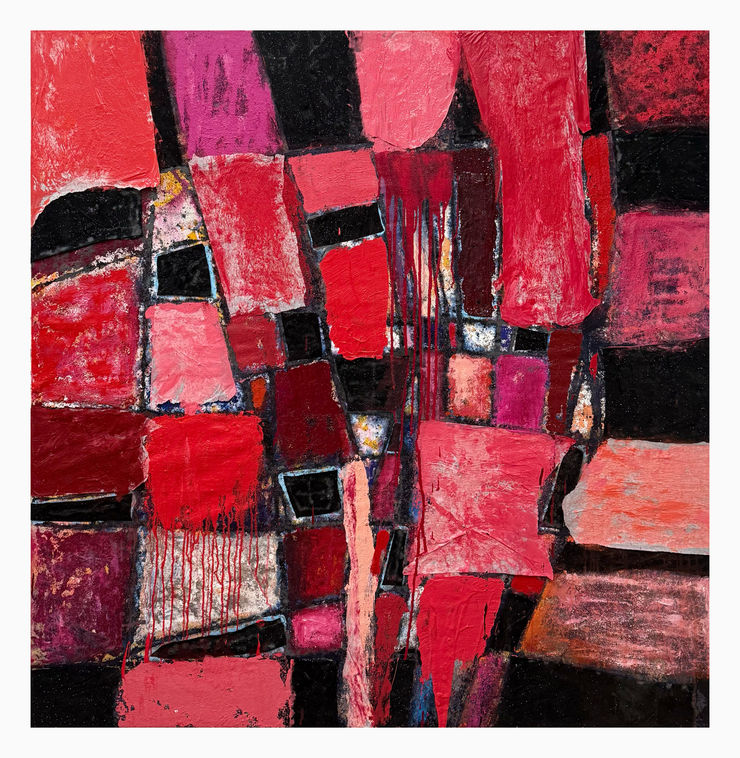
HyunMelting Pot, 2025Acrylic, Sand, Pumice, Paper Towel, and Fiber on Canvas43 1/2 x 34 1/2 in
110.5 x 87.6 cmCourtesy of Latitude Gallery New YorkCopyright The Artist -
HyunBlack Pink, 2025Acrylic, Fabric, Sand, Pumice, Paper and Fiber on canvas
58 x 56 in
147.3 x 142.2 cmCourtesy of Latitude Gallery New YorkCopyright The Artist -
In June ParkTBD, 2025Acrylic on Canvas40 x 30 in
101.6 x 76.2 cmCourtesy of Latitude Gallery New YorkCopyright The Artist -
In June ParkPonytail, 2025Acrylic on canvas12 1/2 x 17 in
31.8 x 43.2 cmCourtesy of Latitude Gallery New YorkCopyright The Artist -
Wenfei QuanUntitled, 202553 x 62 1/2 in
134.6 x 158.8 cmCourtesy of Latitude Gallery New YorkCopyright The Artist -
Wenfei QuanDigital Wound, 2025Oil on Canvas with Silkscreen39 x 59 in
99.1 x 149.9 cmCourtesy of Latitude Gallery New YorkCopyright The Artist -
Wenfei QuanUntitled, 202516 x 53 in
40.6 x 134.6 cmCourtesy of Latitude Gallery New YorkCopyright The Artist -
Cass YaoAnatomy #1, 2025Epoxy Clay, Acrylic Pigment, Raw Silk, Silicone, Velvet Flocking16 x 48 x 7 in
40 x 120 x 18 cmCourtesy of Latitude Gallery New YorkCopyright The Artist -
Cass YaoAnatomy #5, 2025Steel, Epoxy Clay37 x 54 x 16 in
95 x 138 x 41 cmCourtesy of Latitude Gallery New YorkCopyright The Artist -
Andrius Alvarez-BackusJust Between Us, 2025Reclaimed Textiles, Colored Pencil, Tempera, Acrylic on Pine Wood Panel.21 x 48 in
53.3 x 121.9 cmCourtesy of Latitude Gallery New YorkCopyright The Artist -
Andrius Alvarez-BackusI Mistook it for Tenderness, 2025Reclaimed Bedpposts, Epoxy, Soil, Enamel Paintheight 37 in
height 94 cmCourtesy of Latitude Gallery New YorkCopyright The Artist -
Rayer MaA Thousand and One, 2025Calligraphy Paper, Kitchen Gauze, Embroidery Thread, Wheat Starch, Sichuan Peppercorn, Yellow Cypress Bark, Cactus Soil, Red Clay, Pink Sand, Sticky Rice, Roman Cement, Trass Powder, Burnt Umber, Rosy Hair, The Last of Moss, Crate22 1/2 x 19 x 11 1/2 in
57.1 x 48.3 x 29.2 cmCourtesy of Latitude Gallery New YorkCopyright The Artist -
Rayer MaThe Air Is Blue, 2025Umbrella bits and ends of burnt wood / Basket unwoven and plastic sewn / Beeswax-pine rosin-pear leaf goo / Brown sugar-sweet rice-red clay coat / Mop yarn /Sea sponge /Pin threads needle / Vanda orchid root l should have been more careful / After the rain who lost my schoolbook108 x 28 x 12 in
274.3 x 71.1 x 30.5 cmCourtesy of Latitude Gallery New YorkCopyright The Artist